
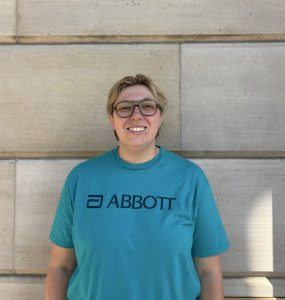
When Aleeza Barkas was diagnosed with a rare form of progressive hearing loss, she expected the medical challenges ahead. What she didn’t expect was that she would have to spend over a year fighting her insurance company for coverage of a medically necessary cochlear implant.
A Progressive Condition
Now a Verona resident and product support scientist, Barkas has lived with hearing loss since childhood. Although hearing screenings first identified concerns when she was in middle school, the condition worsened dramatically over time. Eventually, specialists diagnosed her with a form of hearing loss called sensorineural hearing loss triggered by loud noises, which was extremely rare for her young age.
“My hearing loss wasn’t a loss of volume,” Barkas explained. “It was a loss of understanding speech.”
As her hearing declined, simple daily interactions became increasingly difficult. While working in a clinical laboratory environment, Barkas found it harder and harder to keep up with conversations and technical discussions. The COVID-19 pandemic then further highlighted how much she relied on lip reading.
“People started wearing masks, and that’s when I realized that this was bad,” she said. “I was relying almost 100% on lip reading.”
After meeting with specialists at UW Health, Barkas learned she was a candidate for a cochlear implant, a surgically implanted device that can help restore hearing for some patients with severe hearing loss. However, obtaining insurance approval for the essential device proved far more difficult than anyone expected.
A Frustrating Insurance Battle
Over months of appeals, denials, and rescheduled surgeries, Barkas repeatedly received conflicting information about why coverage was being denied, with reasoning ranging from the device not being “medically necessary” to a lack of necessary documents, all of which Barkas and her medical providers had sent. At one point, the surgery was approved, while the device required for the surgery was denied.
“They approved the cutting of my head, but not the actual implantation of anything,” Barkas said.
The process became increasingly stressful as her hearing continued to deteriorate. Barkas said the decline affected her work, social life, and overall quality of life in general. “My life is being severely affected,” she recalled thinking. “I’m not doing well at work because I can’t hear technical conversations. I’m not going into work because I’m scared to have conversations with people that I’m just going to miss, and my social life is next to nothing because I can’t go to a bar and hear my friends.”
The situation reached a breaking point the day before her surgery. After seeing that now both the surgery and the implant had been denied, Barkas and her family prepared to pay the tens of thousands of dollars out of pocket so the procedure could move forward.
“Luckily, my family was able to max out all of their credit cards and put the money down, just so I could have the surgery,” she said.
Even after the surgery was completed, the insurance problems continued. Barkas spent months trying to understand why claims were still being denied. She knew something was wrong and considered pursuing legal action but was hesitant to take on additional thousands of dollars in legal expenses with no guarantee of success. She was then referred to the Health Justice Clinic.
Finding Support Through the Health Justice Clinic
Through the clinic, Barkas began working with law student advocate Clare, who took on the challenge of communicating with the insurance company, gathering records, and requesting information that had previously been unavailable to Barkas.
“It was worth it because Clare spent way more time on the phone with them than I would have ever been willing or able to,” she said. “There’s a certain way you have to talk to them to get the information you need, and she figured it out and did just that.”
One challenge for Barkas was that her hearing loss itself made communicating with the insurance company difficult. “I didn’t want to call them because what if I miss something they say since I can’t understand?” she said.
Through months of investigation, Clare uncovered information that helped clarify inconsistencies in the insurance company’s explanations and allowed Barkas to better understand what had happened with her claim. The advocacy efforts also helped prepare a compelling potential legal case if further action became necessary, and things were looking like it was.
A Long-Awaited Resolution
Then, exactly a year after her surgery, Barkas learned that a payment had finally been issued and that a reimbursement check was on its way. She credits the win to the frequent contact from her CPP advocate to the insurance company.
Advice for Other Patients
For other patients facing similar insurance challenges, Barkas has a simple recommendation.
“If your case has been appealed, denied, peer reviewed, and denied, come talk to someone because [the insurance companies] are not going to help you,” she said. “Having support from a third party gave me the confidence that I didn’t do something wrong. The whole time I thought I was, because that’s how insurance companies can make you feel for just trying to get the care you need.”
As Barkas prepares for a second cochlear implant surgery this year, she remains hopeful. While she knows another insurance approval process lies ahead, she feels better equipped to navigate it and knows she doesn’t have to face things alone.
“I’m nervous, but I do feel set up well to see the warning signs of things not going my way,” she said.
Most importantly, Barkas says her experience reinforced the value of programs that both educate future advocates and support patients navigating complex healthcare systems.
“I knew that Clare also got super beneficial information out of taking this on, and that was so rewarding for me. I went to UW-Madison for my master’s, so I’m grateful to see that they are still giving students opportunities to learn in ways that also benefit the community.” •