Lawyers in the Doctor’s Office: Partnering to Address Health-Harming Legal Needs
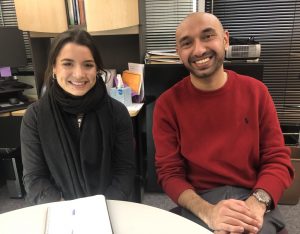
Law Student Monica Delgado and Legal Advocacy Coordinator Sachin Gupte
Many patients and families enter the health care system already burdened with stressful situations. Legal issues can pose significant challenges when people try to secure a job, find stable housing, build credit, and access services.
With funding from the Ira and Ineva Baldwin Wisconsin Idea Endowment Grant, UW law and pre-law students work with patients in local health clinics to resolve health-harming legal issues, such as denials of disability benefits and impending housing evictions.
Overwhelming evidence demonstrates that socioeconomic factors impact health, leading to deep inequities in health outcomes. Substandard housing, lack of insurance and food insecurity are just a few examples. Many of these “health-harming social needs” have a legal solution. Yet, 80 percent of the legal needs of people living in poverty go unmet. The health care setting offers patients the safety and privacy to begin conversations and legal issues that might otherwise go unrecognized are identified. Combining the expertise of two well-established Law School clinical programs, Lawyers in the Doctor’s Office: Partnering to Address Health-Harming Legal Needs puts UW Law and pre-law students in local health clinics to identify health-harming legal issues patients are facing and provide a spectrum of legal services during this two-year project — preventing legal crises and intervening on active legal issues that place additional financial and health burdens on families.
By preventing legal crises and intervening on active legal issues, patients and families learn to avoid additional financial and health burdens. In the clinic, patients experience a higher degree of safety and privacy to begin conversations about otherwise unrecognized legal issues.
“Legal issues can sneak up on people,” says Sachin Gupte, the Center’s legal advocacy coordinator. “We work with them to identify legal solutions to issues that may not initially present as legal problems. But also vice-versa. We connect them with other resources when an issue isn’t ripe for a legal intervention,” he says.
The subjects of the eight projects selected for grants from the Ira and Ineva Reilly Baldwin Wisconsin Idea Endowment are varied but all will help the university contribute knowledge and resources across the state.